A few weeks ago, I had an interesting conversation with someone who had recently gone through the CRM selection process.
Naturally, I was curious about what led them to their decision.
Their answer?
“We’re at $3.5M ARR, so of course we went with Salesforce.”
Of course?
I had questions. Quite a few, actually.
Now let me be clear, there’s nothing wrong with choosing Salesforce, when it makes sense. It’s a powerful platform, and for many businesses, it can be an excellent fit.
But this whole interaction had me scratching my head because annual recurring revenue isn’t typically a requirement in the CRM selection process, aside from potentially wanting to ensure you can afford it.
Naturally, I wanted to dig deeper to understand what was really driving their decision. .
The more questions I asked, the more interesting the conversation became.
Their Actual CRM Requirements
First, a little context.
The person driving the CRM selection process for this company wasn’t in Sales, Marketing, or Customer Services. They had used a CRM once before in their career so they became the decision maker.
That alone doesn’t disqualify someone from leading a software evaluation, but it does make gathering requirements from the people who will actually use the software particularly important.
So I started asking questions.
How big is your team?
Ten people.
Are you expecting to scale to hundreds or thousands of employees?
Not really. Maybe twenty people eventually.
Do you have a particularly complex sales process?
Nope.
Their process was fairly straightforward:
A potential customer visits the website, books a demo, someone from Sales follows up, hosts the demo, and hopefully closes the deal.
Any unusual compliance requirements or highly specialized workflows?
Nope. Everything they explained didn’t require a particularly complex CRM implementation.
None of this meant Salesforce couldn’t work for them.
But I still hadn’t heard a requirement that explained why Salesforce was the obvious choice.
I probed further and asked how they had evaluated their options.
When Familiarity Becomes a CRM Selection Strategy
It turned out they were only familiar with a handful of CRM vendors.
So they asked their sales team whether Salesforce would be okay for their needs.
The response was essentially:
“Yeah, we’ve used it before. It’s fine.”
And that was a significant part of the evaluation.
I asked whether the sales team had used Salesforce in the same industry they were operating in now.
They hadn’t.
Then I asked a few more questions.
Do you have a Marketing team?
Yes.
Anyone handling Customer Service?
Yes.
Did you ask them what they needed from the CRM?
No.
Now we were getting somewhere. They failed to consider all the pieces of the puzzle.
CRMs aren’t always jus ta sales tools. Marketing and Customer Service teams tend to rely on them just as heavily. Yet, in this instance their requirements hadn’t been part of the conversation.
Previous experience with a platform is worth considering. Familiarity can reduce training time and make adoption easier.
But familiarity shouldn’t be confused for suitability.
A CRM that worked well at a previous company, in a different industry, with different workflows, isn’t automatically the best fit for your current business.
“We’ve used it before” is useful information but it shouldn’t be the primary driver of your assessment.
Companies sometimes start with the vendors they recognize, rather than the problems they need to solve.
And Then There Was the Logo
At this point, I mentioned a few other CRM options worth exploring.
They opened the website of one of my recommendations.
I was curious to hear what they thought about its capabilities, integrations, or suitability for their team.
Instead of acknowledging that tool may have been a better fit, they said “I still would have gone with Salesforce. This vendor has a weird logo.”
A weird logo.
Branding isn’t completely irrelevant. A company’s website, presentation, and reputation can influence how much confidence a buyer has in a product, but there’s a big difference between questioning a vendor’s credibility and dismissing its software because you don’t particularly like its logo.
Especially when we’re talking about a business-critical system.
This was the moment when I started wondering whether the decision had really been about CRM requirements at all.
Or whether the company had already decided what kind of CRM a $3.5M ARR business was “supposed” to have.
The CRM You Need vs. The CRM You Think You Should Have
There’s an interesting shift that sometimes happens as companies grow.
In the early stages, software decisions tend to be pragmatic. Teams look for something affordable, easy to implement, and capable of solving their immediate problems.
Then the company hits a milestone.
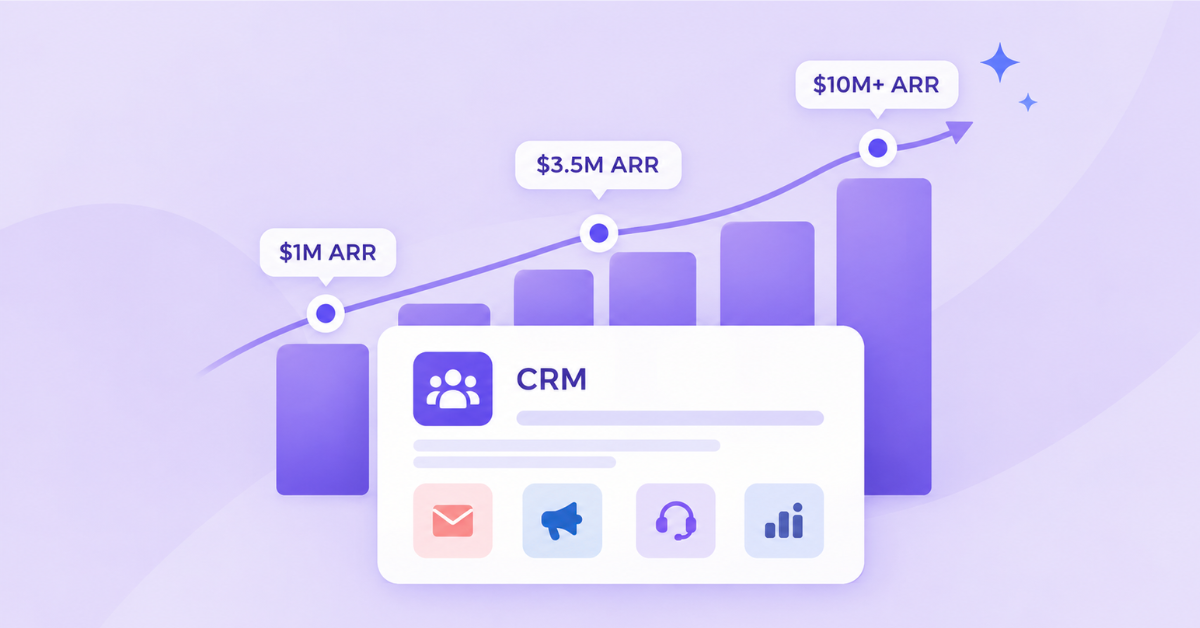
Maybe it’s $1M ARR. Maybe $3.5M. Maybe $10M.
Suddenly, the conversation changes.
“We’re a serious company now. Shouldn’t we be using more serious software?”
And sometimes, without anyone explicitly saying it, “serious software” becomes synonymous with a familiar enterprise brand.
Established vendors can offer extensive functionality, mature ecosystems, and the reassurance that comes with widespread adoption.
But there’s a difference between choosing a platform because its capabilities match your business and choosing it because you believe your business has reached the stage where it should be using that platform.
One is a requirements-driven decision. The other is an assumption.
And assumptions can get expensive.
In this particular case, it got very expensive.
Buying an Adult Suit for a Toddler
During our conversation, they mentioned something else: their new CRM required extensive customization for a very straightforward sales process.
And I couldn’t help thinking of this analogy: Imagine buying a suit for an adult and tailoring it to fit a toddler.
The reasoning? “Well, they’ll grow into it eventually.”
Except the toddler needs to wear it today. So you spend time and money tailoring it to fit, only for it to still look a little ridiculous.
That’s how some CRM implementations feel to me.
Too often businesses buy software built for a level of complexity they don’t have yet, then spend significant time and money adapting it to their much simpler processes—all for capabilities they might need someday.
Of course, planning for growth matters. But there’s a difference between choosing scalable software and paying for complexity you may never need.
Future-proofing shouldn’t mean making the present unnecessarily difficult.
Especially when we’re talking about a ten-person company with no plans to grow into a team of hundreds or thousands anytime soon.
The Investment: Six Figures a Year. For What?
Then we got to the cost.
They were expecting to spend six figures annually on their CRM.
Six figures.
For a ten-person company with a relatively straightforward sales process.
That’s at least $100,000 a year, without even considering how much of that investment is going toward functionality the business actually needs.
Could Salesforce deliver that level of value for some ten-person companies?
Absolutely.
A small team can have extraordinarily complex requirements. Company size alone doesn’t determine which CRM is appropriate, any more than ARR does.
But based on the requirements described to me, I could immediately think of numerous alternatives that are capable of supporting their workflows with substantially less customization. Because they were built for that industry.
Several could potentially have cost a fraction of what they were planning to spend, without requiring dedicated internal development or operations resources for basic workflows.
That doesn’t mean the cheapest CRM is automatically the right one, though.
It means the cost should be justified by the value it delivers.
The question isn’t whether you can afford a six-figure CRM contract. It’s whether your business actually needs one.
If it doesn’t, those savings could be invested back in your team, or to expand and reach new audiences.
More Features Don’t Necessarily Mean More Value
One of the most persistent assumptions in software purchasing is that more functionality equals a better product.
More dashboards. More automation. More customization. More everything. But functionality only creates value when it solves a real problem.
An advanced reporting engine isn’t particularly valuable if nobody needs those reports.
A sophisticated automation builder doesn’t help much if your team only needs three simple workflows.
And a highly customizable platform can become a burden if the company doesn’t have the resources to configure and maintain it.
The question shouldn’t be:
Which CRM can do the most?
It should be:
Which CRM can do what we actually need, without introducing unnecessary complexity?
Features Don’t Matter If Your Team Won’t Use Them
There’s another consideration that deserves more attention: adoption.
A CRM can offer incredible functionality and still fail to deliver value if the people expected to use it find it unnecessarily complicated.
Sales teams need to manage pipelines and customer relationships. Marketing teams need to run campaigns, track engagement, and nurture leads. Customer Service teams need to resolve issues and maintain customer context.
None of them should have to fight the software to do their jobs.
That’s why involving actual users from the relevant departments in the selection process matters.
The best CRM isn’t the one with the longest feature list. It’s the one your team can use effectively to achieve its goals.
Revenue Is Context, Not a Requirement
ARR isn’t irrelevant to CRM selection. It can help establish your budget and provide context about growth and available resources.
But it doesn’t tell you how your teams operate, which integrations you need, or how much customization your business requires.
And it certainly doesn’t determine which CRM you should buy.
Revenue tells you something about the size of your business. It doesn’t tell you how your business works.
So, What Should Determine Your CRM Choice?
Instead of focusing on ARR, start with how your business actually operates, what your team needs, which tools you rely on, and how much complexity you can realistically support.
Scalability matters, too. But there’s a difference between planning for realistic growth and paying today for capabilities you might never use.
The goal isn’t to find the most powerful CRM. It’s to find the right fit for your business today, with room to grow when the time comes.
Not sure where to start? Explore our guide to the best CRM software for SMBs to compare your options and find the right fit for your team.
Buy for the Business You Run
By the end of our conversation, the person I was speaking with still believed they’d made the right decision.
And that’s entirely their prerogative.
They did, however, acknowledge that their selection process hadn’t been ideal.
And maybe, just maybe, a six-figure annual CRM commitment was more than they actually needed.
I don’t know whether they’ll ultimately be happy with their choice.
They might be.
If the platform works well for their team, supports their processes, and delivers the value they expect, that’s what matters.
But the conversation stayed with me because it highlighted something I wish more businesses would question.
When did reaching a revenue milestone become a reason to buy a particular software brand?
Growing up as a business doesn’t necessarily mean growing into more complicated software.
Sometimes growth means needing more sophisticated tools.
Sometimes it means needing simpler ones.
And sometimes it means realizing the tools you already have are perfectly adequate.
Your ARR is a measure of your business’s success, it isn’t a sign you need to purchase specific software.
And, if you take nothing else from this story let it be this,a CRM shouldn’t be a status symbol.
Choose your CRM based on what your business needs, not what you think a company of your size is supposed to use.
We built Vendor Box to help businesses evaluate CRM options based on their actual requirements rather than brand familiarity or assumptions.
Because ultimately, the goal isn’t to own the most impressive CRM, it’s to find the one that fits.
Vendor Box helps businesses discover and compare CRM solutions based on their specific needs, workflows, and priorities.